


Every System Has Its Own Version of the Product
Ask four systems about the same SKU and you’ll often get four answers.
The ERP has a short description someone typed during item setup. The PIM has a richer record, but only for the categories your team has had time to build out. The e-commerce platform has whatever was imported last, plus the manual edits made since. And somewhere there’s a spreadsheet with the version a manufacturer sent last spring.
Keeping them aligned is a standing job. Your team exports from one system, reconciles against another, and fixes conflicts by hand. Every manufacturer update starts a new round, because the content arrives in a different format from every supplier and has to be reworked before any system can use it.
The result is a product data architecture held together by people.
Most distributors have tried to solve this with connectors. Middleware moves records between the ERP and the storefront. Scripts sync the PIM. Each project helps, and each one adds a new place for data to drift.
That’s because the integration problem is usually a content problem. Connectors move data between systems, but they don’t fix what’s entering them. If manufacturer content arrives incomplete, inconsistently named, and in a different structure from every supplier, a faster pipe just delivers the same problem to more places.
Replatforming doesn’t fix it either. A new ERP or PIM means a long, expensive migration—and on the other side, the manufacturer content still arrives the same way it did before.
Source. Manufacturers publish approved content through SYNDICATION/io, so the information entering your stack starts from the manufacturer’s own source of truth.
Enrich. Acadia, DDS’s Product Data Delivery Platform with PIM-like capabilities, applies AI-assisted categorization, normalization, and naming, so content from every supplier arrives in one consistent structure.
Deliver. CONTENT/io delivers that content into your ERP, PIM, and e-commerce platform—each in the format it requires.
In practice, product data integration with DDS works like this:
Map your systems. We document where product content needs to land, which fields each system expects, and how often each one needs updates.
Match your catalog. Your SKUs are matched against 12.8M+ enriched products from 2,194+ manufacturer brands.
Enrich once. Content is categorized, normalized, and named a single time in Acadia—not separately for every destination.
Deliver to every system. Native connectors, scheduled exports, and APIs deliver content daily, hourly, or on demand. Exports are unlimited, with no throttling.
Update everywhere at once. When a manufacturer revises a spec or releases a product, the change reaches every connected system from the same source.
Ready to see it in action?
Book a DemoClear Boundaries for Your Architecture
DDS replaces manual effort—not your systems.
DDS supplies: product content. Names, descriptions, attributes, specifications, categories, images, 360° views, videos, and documents.
Your systems keep their roles. Your ERP remains the system of record for your business. Your PIM, if you run one, remains where your team governs content. Your e-commerce platform remains your storefront. And if you use integration middleware to move orders and customer records, it keeps doing that job.
DDS makes sure that every one of those systems is working from the same complete, current product content.


One version of every product.
Your ERP, PIM, and storefront draw from the same source, so the conflicts your team reconciles today stop being created.

Reconciliation work drops.
Teams report a 60–80% reduction in time spent on manual data management and an 80%+ reduction in spreadsheet cleanup.

No migration project.
DDS works with the stack you have. Implementation is measured in weeks, not the quarters or years a replatform takes.

Faster time to market.
New SKUs and updates go live in hours or days rather than weeks. Distributors working with DDS have launched new products up to 4× faster.

Scale without rework.
The platform scales from 10,000 SKUs to over a million, and adding a system or a supplier doesn’t mean building another custom feed.
Systems DDS Connects
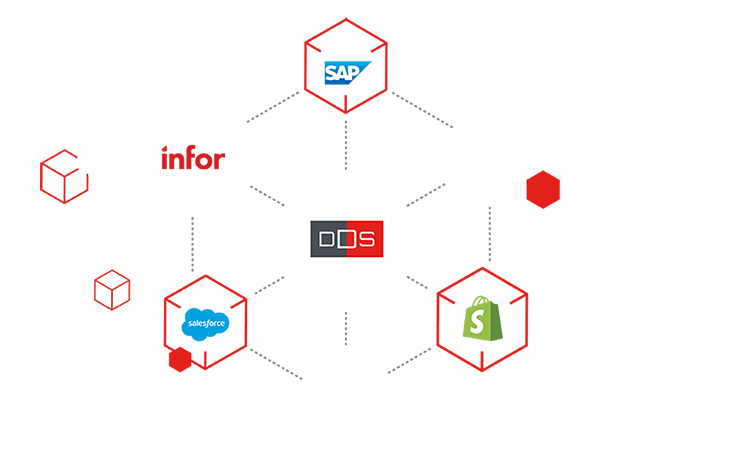
With 489+ integrations, DDS delivers content to the platforms distributors run today—including e-commerce platforms such as Shopify, BigCommerce, Magento, and Optimizely; ERPs such as SAP, Epicor, Infor, and NetSuite; and PIMs such as inRiver.
Running something custom or homegrown? Flexible export formats and APIs cover it, and your IT team stays in control of where content lands and how often.
Where Manufacturers Fit
Manufacturers are the upstream source of truth. Through SYNDICATION/io, they publish approved product information once, and DDS carries it accurately into distributor systems. That means the content moving through your stack stays tied to what the manufacturer actually approved—not a copy of a copy from three exports ago.

What is product data integration?
Product data integration is the process of connecting the systems that store and use product information—typically ERP, PIM, and e-commerce platforms—so they work from consistent, current content instead of separate, conflicting versions.
Is DDS a product information management (PIM) system?
No. Acadia is a Product Data Delivery Platform with PIM-like capabilities. It's technology-agnostic and works alongside your existing ERP, PIM, and e-commerce systems.
Does DDS replace our ERP or PIM?
No. DDS is the content delivery layer that supplies your existing systems. It doesn't replace them.
We already use integration middleware. Do we still need DDS?
They solve different problems. Middleware moves data between your systems. DDS supplies the product content those systems need—complete, consistent, and manufacturer-approved—so what moves through your stack is right to begin with.
How is content delivered?
Through native connectors, scheduled exports, and APIs—daily, hourly, or on demand, with unlimited exports.
How long does implementation take?
Implementation is measured in weeks.