
Wholesale Fastener Product Data: A Distributor’s Comparison Guide to Closing the Content Gap
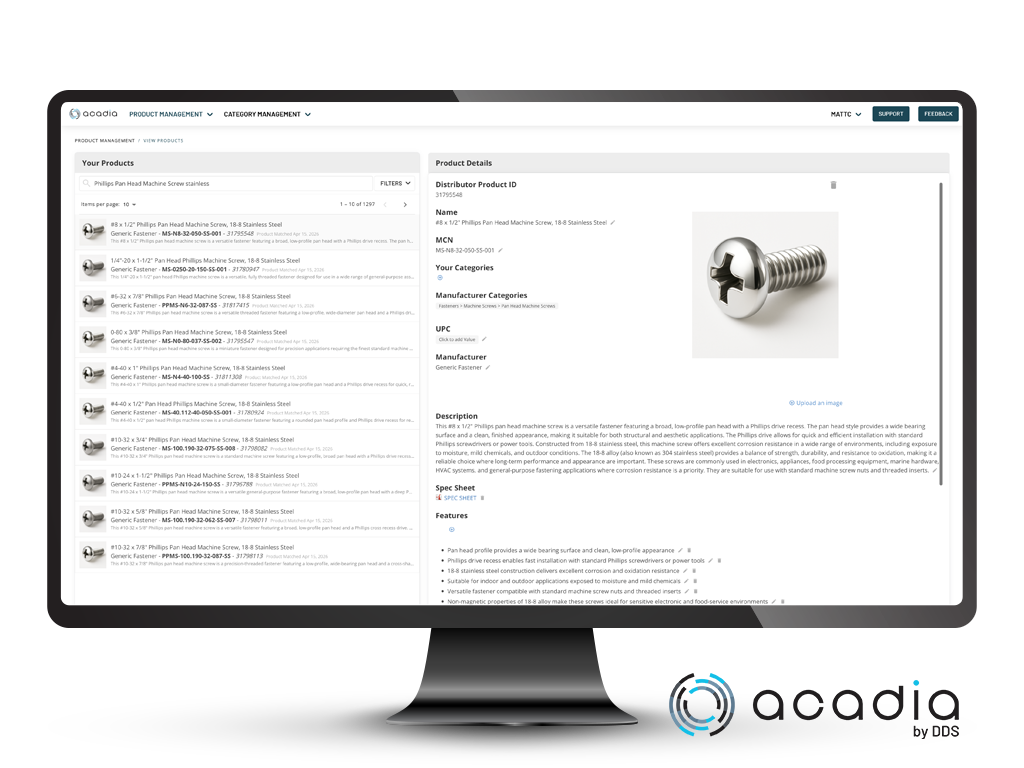
In every other industrial vertical—electrical, plumbing, HVAC, industrial supply—the product content challenge is about cleaning up what manufacturers already provide. In fasteners, the problem is more fundamental: the content rarely exists in the first place.
Most fastener distributors operate with nothing more than a part number and a basic ERP description. No images. No structured attributes. No spec sheets. No marketing copy. Every distributor sitting on that reality knows what it costs them: empty product pages, customers who can’t find what they need online, and an e-commerce channel that quietly underperforms peers in better-cataloged industries.
This guide is for fastener distributors evaluating how to finally close the wholesale fastener product data gap. We’ll compare the real options on the table today—in-house teams, generic PIM software, industry data pools, web scraping, off-the-shelf AI, and purpose-built platforms like DDS—then walk through a quantified ROI scenario for a representative mid-sized fastener distributor. Manufacturers and the software vendors who serve fastener distribution will find a section dedicated to them near the end.
Why Fastener Product Data Is the Toughest Content Gap in Industrial Distribution
Fasteners are uniquely punishing as a digital category for one reason: attribute density.
A single bolt isn’t just a bolt. It’s defined by thread size, pitch, threads per inch, grade or class, tensile strength, proof load, hardness, material, alloy designation, finish, coating type, head style, drive type, length, diameter, wrench size, thread direction, and applicable standards (DIN, ISO, ASTM, SAE). Multiply that across 40,000–500,000 SKUs in a typical fastener distributor’s catalog and you have one of the deepest, most structured product data requirements in all of B2B distribution.
That’s also exactly the depth modern e-commerce demands—faceted search, parametric filtering, cross-reference matching, downloadable spec sheets. Buyers expect to find a “½-13 x 3 Grade 8 hex cap screw, zinc plated, ASME B18.2.1” with three filters. Without structured attribute data, that’s impossible.
The reason this gap exists is structural. The fastener manufacturing base is fragmented, and most fastener manufacturers historically haven’t invested in distributor-ready digital content. Brighton-Best is one of the few exceptions. For everything else—dozens of brands a typical distributor carries—structured content is rare or nonexistent.
That’s the problem every fastener distributor is solving for, whether they realize it or not. Here’s how.
Comparing Your Options: How Fastener Distributors Are Closing the Data Gap Today
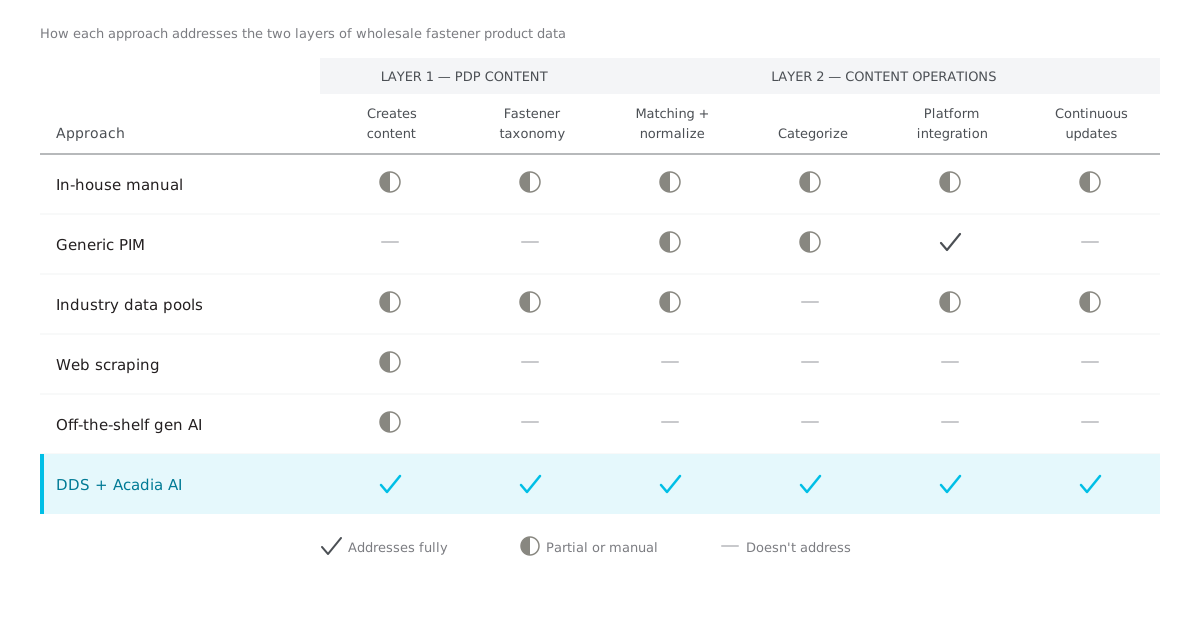
Before walking through the options, it’s worth being precise about what “solving” wholesale fastener product data actually requires. There are two layers, and most approaches only address one of them.
Layer 1 — PDP content. The stuff that ends up on a product detail page: product name, description, images, structured attributes, spec sheet. This is what most people picture when they think about “fixing product data.”
Layer 2 — Content operations. Everything that has to happen for that PDP content to be usable in your business: matching incoming data to your existing items (MCN logic), assigning categories to your taxonomy, normalizing attribute values so “½ in,” “0.5 in,” and “12.7 mm” roll up correctly, enhancing ERP-style names into customer-readable ones, hosting and serving spec sheet documents, integrating delivery into your ERP / PIM / e-commerce platforms, and keeping all of it continuously updated as manufacturers change things.
Layer 1 is content. Layer 2 is the pipeline that turns content into something your business can actually run on. An option that only solves Layer 1 leaves the harder, more expensive half on your team.
With that lens, here are the six approaches in market. Each makes sense in some context, and each has limits when applied at fastener-catalog scale.
1. In-House Content Creation (Manual)
The default for most fastener distributors. A small product content team writes descriptions, sources images, and structures attributes by hand—and then handles the entire downstream pipeline themselves.
- Where it works: Small specialty catalogs, niche product lines with limited substitutions.
- Where it breaks: Throughput, in both layers. A skilled product content specialist might fully structure 30–50 fastener SKUs per day if templates are well-built—and that’s before matching, categorization, normalization, integration, and document hosting work. Across a 40,000-SKU catalog, the first pass alone is 4–8 person-years; ongoing operations (new SKUs, supersedes, manufacturer corrections, re-syndication to platforms) become permanent backlog. Most fastener distributors don’t have the team for it, and the ones who do find the team is permanently in catch-up mode.
2. Generic PIM Software (Salsify, Akeneo, inriver, Stibo, and others)
Modern PIM platforms are excellent at managing, governing, and distributing product content—once it exists and once it’s been matched, normalized, and categorized.
- Where it works: Distributors with mature data already in place who need governance, workflow, and channel syndication on top of an existing content foundation.
- Where it breaks for fasteners: PIMs sit at the end of the content pipeline, not the start. They don’t create PDP content (Layer 1) and they don’t perform matching, normalization, or category mapping against your taxonomy (Layer 2)—they expect that work to already be done. Implementations typically run 6–18 months and cost six figures, and the schemas they ship with are usually retail-leaning, not built around fastener taxonomy. Distributors regularly spend a year and a budget cycle deploying a PIM, then discover the actual problem—the missing data and the operational pipeline to manage it—is still in front of them.
3. Industry Data Pools (IDEA, AD, etc.)
Centralized exchanges where manufacturers publish data once and distributors pull it. Strong in some verticals.
- Where it works: Electrical (IDEA), where the manufacturer base bought into the model decades ago.
- Where it breaks for fasteners: There is no equivalent fastener data pool with comprehensive coverage. AD covers some, but most long-tail fastener manufacturers don’t publish into any centralized exchange.
4. Web Scraping and Homegrown Scripts
Build crawlers to pull data from manufacturer or competitor sites and parse it into structured attributes.
- Where it works: Tactically, for one-off projects with a clear source.
- Where it breaks: Most fastener manufacturer sites are themselves content-thin—scraping a brochure-quality site doesn’t produce e-commerce-quality data. Competitor scraping is legally and ethically fraught. And scrapers are brittle: every site change breaks the pipeline. You end up with a fragile system maintained by IT instead of solving the underlying problem.
5. Off-the-Shelf Generative AI (Used Directly)
A newer entrant. Use a general-purpose chatbot or API to draft descriptions and infer specs.
- Where it works: One-off copy drafts, ideation, internal-use summaries.
- Where it breaks for fasteners: Off-the-shelf AI only touches a slice of Layer 1. It can draft text for an individual product, but it can’t reliably map to fastener-specific taxonomy or compliance standards (DIN/ISO/ASTM/SAE), it doesn’t perform any of the Layer 2 work—matching incoming data to your existing items, normalizing attributes across manufacturers, assigning categories to your taxonomy, enhancing ERP-style names, hosting documents, integrating into your ERP/PIM/e-commerce stack, or keeping any of it updated when manufacturers change things—and it has no governance or quality control. The output is one product’s worth of unstructured text. The pipeline that turns that text into something your business can run on still falls entirely on a human team.
6. Purpose-Built Wholesale Fastener Product Data Platforms (DDS + Acadia AI Product Creation)
Platforms designed specifically to source, generate, normalize, and deliver wholesale fastener product data into the systems distributors already use—addressing both layers of the problem in one pipeline.
- How DDS approaches Layer 1 (PDP content): Acadia’s AI Product Creation engine builds a comprehensive library of fastener content from the ground up—structured features, full technical specifications, descriptions, images, and downloadable spec sheets—mapped to fastener-specific attribute schemas and compliance standards (DIN, ISO, ASTM, SAE).
- How DDS approaches Layer 2 (content operations): Acadia performs the operational work that makes Layer 1 content usable: product file matching against your existing items and MCN logic, category assignment to your taxonomy, attribute normalization across manufacturers (so “½ in,” “0.5 in,” and “12.7 mm” reconcile), name enhancements that turn ERP descriptions into customer-readable names, document hosting for spec sheets, continuous updates as manufacturers change things, and direct delivery into the ERP, PIM, and e-commerce platforms already in your stack—including Shopware, BigCommerce, Shopify, Magento, Optimizely, and 400+ other endpoints.
- Where it fits: Distributors who need to close the content gap and run the pipeline at catalog scale, without rebuilding their tech stack and without hiring a content team they don’t have. DDS is the exclusive product content provider for NetPlus Alliance and Sphere 1—the two largest fastener buying groups in North America—which is a useful proxy for industry fit.
DDS isn’t the only choice a fastener distributor can make, and it doesn’t replace a PIM if you have one. It complements existing infrastructure by filling the two layers that are actually missing: the content itself, and the operational pipeline that puts it to work.
At a Glance: How Each Approach Addresses the Two Layers
The ROI of Fixing Wholesale Fastener Product Data
Before the worked example, here are the operational benchmarks DDS sees across distributor deployments:
- 60–80% reduction in manual product content management time
- Up to 30% lift in digital conversion rates as product pages move from empty to complete
- Up to 4× faster time-to-market for new and updated SKUs
- 80%+ reduction in manual spreadsheet cleanup
- 15–25% reduction in “product not as described” returns
Worked Example: A Mid-Sized Fastener Distributor (Illustrative)
The numbers below are an illustrative model, not a guarantee. They’re sized to a representative mid-sized fastener distributor. Real results vary by catalog mix, online traffic, and current digital maturity.
Baseline (typical mid-sized fastener distributor):
- $75M annual revenue
- 40,000 active SKUs
- ~5% (≈2,000 SKUs) with usable e-commerce content; the rest carry a part number and an ERP description
- Online revenue: 8% of total ≈ $6.0M
- Two product content FTEs ≈ $200K loaded cost
- Returns running at ~4% of online revenue ≈ $240K
- New manufacturer line onboarding: ~30 days
12 months after deploying DDS (illustrative outcomes):
- ~95% of catalog covered with images, structured specs, descriptions, and spec sheets
- Conversion lift of 20–30% on existing online traffic → +$1.2M to +$1.8M in online revenue
- 70% reduction in manual content workload → ~$140K in FTE capacity redirected to higher-value work (vendor management, merchandising, exception handling)
- 15–25% reduction in returns → ~$36K–$60K in cost savings
- New manufacturer onboarding compressed from 30 days to 3 → faster revenue capture on new lines
Conservative annualized value (low end of all ranges): ~$1.4M in measurable benefit—before accounting for compounding effects like organic search visibility, expanded SKU breadth driving new traffic, and the strategic value of being the fastener distributor in your region with a real digital catalog.
Most fastener distributors evaluating DDS find the breakeven case is built almost entirely on the conversion lift alone. FTE recapture, returns reduction, and onboarding speed are upside.
What This Looks Like for Manufacturers and Software Vendors
The wholesale fastener product data gap doesn’t only affect distributors. It propagates across the channel.
For fastener manufacturers:
The cost of fragmented content is paid every time a distributor delays a product launch, deprioritizes a SKU because there’s no marketable data, or formats the same product differently across channels. DDS gives manufacturers a single delivery point: ship structured product data once, and DDS routes it—with normalized taxonomy, enriched attributes, and AI-generated gap fills where needed—into 400+ distributor endpoints. The result is consistent presentation across the channel without bespoke distributor-by-distributor work.
For software vendors that serve fastener distribution:
Every e-commerce platform, B2B commerce engine, ERP, and PIM serving fastener distributors runs into the same wall: the platform is only as useful as the content it can display. A search experience without attributes can’t filter. A PDP without specs can’t convert. DDS sits upstream of those platforms as a normalized source of wholesale fastener product data, so software providers’ fastener customers can actually use the features they paid for. For ERP and PIM partners specifically, DDS removes the burden of building fastener-specific attribute schemas in-house.
The Bottom Line
Fastener distribution doesn’t lose to better competitors. It loses to empty product pages.
The wholesale fastener product data gap is solvable—but the path matters, and the right path has to address both layers. Generic PIMs sit downstream of the work and don’t solve it. Data pools don’t cover the category. Manual content creation doesn’t scale at catalog volume across either layer. Off-the-shelf AI only touches a slice of one layer and leaves the operational pipeline untouched.
Purpose-built platforms that generate fastener PDP content and run the matching, normalization, categorization, integration, hosting, and update pipeline that follows—into the systems distributors already use—are the first approach where the math works at full catalog scale.
If you’re evaluating how to close this gap for your business, the DDS fastener industry page walks through the platform in more depth—including how Acadia AI Product Creation builds fastener content from the ground up and how that content flows into your existing stack.
Talk to a fastener industry specialist →