


Approved Isn't the Same as Ready
The content your manufacturers send is usually accurate. It just isn’t ready for your site.
One supplier lists “Voltage.” Another uses “Volts.” A third puts it in the description and leaves the field empty. Product names read like catalog codes. Categories follow the manufacturer’s structure, not yours. Some products arrive without images; others arrive with six attributes when your filters need twenty.
None of it is wrong, exactly. But a product with a cryptic name, a missing spec, and the wrong category is a product buyers can’t find, can’t filter to, and can’t trust enough to order.
So your team does the translation by hand. They rename, recategorize, fill gaps, and reconcile units—SKU by SKU, supplier by supplier. And every other distributor selling the same products is doing the same work on the same content, separately.
Product data enrichment is the work of turning source content into complete, consistent, searchable product records. For a wholesale distributor, it usually comes down to four things:
Categorization — placing each product in the right spot in your taxonomy, so it shows up where buyers browse.
Attribute normalization — standardizing attribute names, units, and values across suppliers, so one filter works for every brand.
Naming — building clear, consistent product names that buyers and search engines can read.
Completeness — finding the gaps that keep a product from being publishable, before it goes live.
Product data quality depends on all four. Missing any one of them, and the listing underperforms.
How Acadia Handles Product Data Enrichment
Acadia is DDS’s Product Data Delivery Platform with PIM-like capabilities. It takes manufacturer content and applies AI-assisted enrichment before delivery, so your team reviews finished records instead of building them.
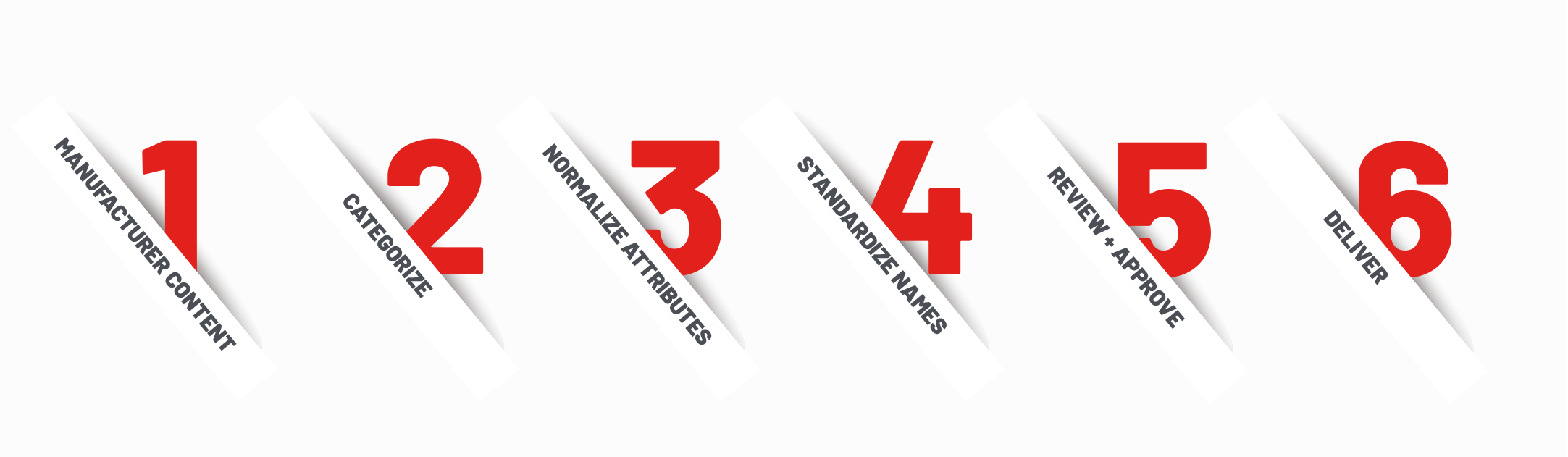
Start from manufacturer content. Product content comes from the manufacturer, drawn from a network of 12.7M+ enriched SKUs across 2,160+ brands. The manufacturer’s specs remain the source of truth.
Categorize. Acadia’s AI-assisted classification places each product in the right category, so similar products from different brands land together.
Normalize attributes. Acadia standardizes attribute names, units, and values across suppliers—”Voltage,” “Volts,” and “V” become one field, with one format, behind one filter.
Standardize names. Acadia generates consistent, readable product names and search-friendly fields, built from the product’s actual attributes rather than the manufacturer’s internal shorthand.
Review and approve. Enhancements move through governed review and approval workflows in Acadia, so nothing reaches your site without oversight.
Deliver. Enriched records land in your e-commerce platform, ERP, or PIM in the format each system requires—and stay current as manufacturers update their content.
Interested in learning more?
Book a DemoManufacturer Authority Stays Intact
Product content enrichment shouldn’t mean rewriting what the manufacturer said about its own product.
Manufacturers create and approve their source content and publish it through DDS. Acadia’s enrichment improves how that content is structured, categorized, and named for your catalog—without overwriting the specifications the manufacturer approved.
The result is content that’s both channel-ready and trustworthy: the manufacturer’s facts, in a form your site can actually use.


Products go live complete.
Records arrive categorized, normalized, and named, so publishing becomes a review step instead of a rebuild.

Search and filters that work.
Consistent attributes across every brand make faceted navigation useful. Buyers narrow by the specs they shop on and find the product instead of leaving.

One standard across every supplier.
Whether content comes from your largest manufacturer or your smallest, it reaches your site in the same structure, with the same naming conventions.

Measurable commercial results.
Distributors see up to a 30% lift in digital conversion after implementing DDS content, and a 15–25% reduction in “product not as described” returns.

Capacity back.
Teams report a 60–80% reduction in time spent on manual data management and an 80%+ reduction in spreadsheet cleanup. Your content team moves from fixing records to merchandising them.
Works With the Stack You Already Have
Acadia isn’t a PIM replacement. If you run a PIM, Acadia feeds it enriched content. If you don’t, its PIM-like capabilities give your team a place to review, govern, and approve content before it goes live.
With 487+ integrations—including Shopify, BigCommerce, Magento, and Optimizely—enriched content is delivered in the format each destination requires. Custom systems are covered through flexible export formats and APIs.

Where Enrichment Fits
Enrichment is what makes the rest of your content work pay off. SKU onboarding gets products online. E-commerce catalog management keeps them current. Product data enrichment makes sure what goes online is complete, consistent, and findable.

What is product data enrichment?
Product data enrichment is the process of improving source product content so it's complete, consistent, and searchable—categorizing products, normalizing attributes, standardizing names, and filling gaps before the content is published.
Is Acadia a PIM?
No. Acadia is a Product Data Delivery Platform with PIM-like capabilities. Many distributors use it alongside a PIM; others use its built-in tools to review and govern content without one.
Does AI change the manufacturer's product information?
No. Acadia's AI-assisted enrichment improves categorization, normalization, and naming. The specifications the manufacturer approved remain the source of truth.
Who reviews enriched content before it goes live?
Enhancements move through governed review and approval workflows in Acadia before delivery.
What's the difference between product data enrichment and product content enrichment?
In practice, the terms are used interchangeably. Both describe improving product records so they're ready to publish and perform online.