
Two Ceilings Built Into a Bundled E-Commerce Platform—and How KYKLO Distributors Are Removing Them
If you run your storefront on KYKLO, you got online earlier than most distributors and you took product content seriously when many of your peers didn’t. That’s the hard part, and it’s worth crediting.
But two things tend to surface once a content-driven storefront has been live for a while, and we hear them from distributors constantly:
- The catalog is never quite complete enough for the actual product mix you carry.
- The platform handles the basics, but you’ve outgrown what it can do.
Neither is a reason to second-guess getting started. Both, though, point to the same structural issue—and once you see it, it’s hard to unsee.
The Real Problem: One Vendor, Two Ceilings
When your storefront and your product data come bundled inside a single platform, you inherit two ceilings you don’t control:
- A catalog ceiling. Your online catalog is only ever as complete as that one platform’s content coverage. If a manufacturer you stock isn’t well-covered, that’s where your product pages stop.
- A capability ceiling. Your customer experience is only ever as capable as that platform’s feature set. New B2B functionality arrives on the vendor’s roadmap, on the vendor’s timeline—not yours.
Both ceilings limit growth. Neither is in your hands. And because they’re bundled together, you can’t fix one without taking on the other.
The distributors who solve this permanently do one thing: they stop treating “the storefront” and “the product data” as the same purchase.
Decoupling: Where Each Problem Actually Gets Solved
Once you separate the storefront from the data layer, each ceiling becomes a solvable problem with a purpose-built answer.
The Catalog Gap Is a Data Problem—Solved by DDS
Here’s a truth most distributors learn the hard way: counting on a single platform’s built-in catalog to cover your full product mix rarely works out. Even manufacturers themselves often don’t have clean, sales-ready content for every SKU.
That’s precisely the problem DDS exists to solve. Instead of relying on whatever one platform happens to include, DDS is an independent product data layer that sources and enriches content from 1,700+ manufacturer brands across 12.5M+ SKUs, matches it to the products you actually stock, and keeps it current automatically.
In a modern stack, DDS delivers that content into your storefront in real time—and just as importantly, your catalog stays portable. It’s never trapped inside a single platform again. The completeness ceiling simply goes away.
The Capability Gap Is a Platform Problem—Solved by Shopify
A basic storefront caps you at the essentials. A full B2B platform doesn’t.
Shopify gives distributors a modern, secure, scalable foundation built for both B2B and B2C: customer-specific pricing and catalogs, self-service ordering, strong performance, and a merchant ecosystem that keeps adding capability year over year. Rather than waiting on one vendor’s roadmap, you tap into ongoing investment driven by a large, diverse merchant base.
In other words: the feature ceiling goes away, too.
Connecting It to Your Reality—Symmetry Commerce
None of this matters if it disrupts the systems you run every day. That’s where Symmetry Commerce comes in—a Shopify-focused agency that works specifically with B2B and distributor organizations.
They handle the practical questions distributors actually ask:
- What Shopify looks like in a real distributor environment
- How ERP integration typically works
- What’s involved in migrating off your current platform
- How to do it all without disrupting internal systems
This is why DDS is comfortable pointing distributors to Symmetry as a preferred partner when evaluating Shopify. The conversations are grounded in distributor realities, not generic platform pitches.
Why This Combination Works
Distributors moving to this approach aren’t chasing the newest tool. They want a setup where:
- Catalog completeness is sourced independently and never capped by one vendor
- Platform capability scales with demand instead of limiting it
- Core systems stay intact—the ERP remains the system of record
- No single vendor decision can put the whole operation at risk
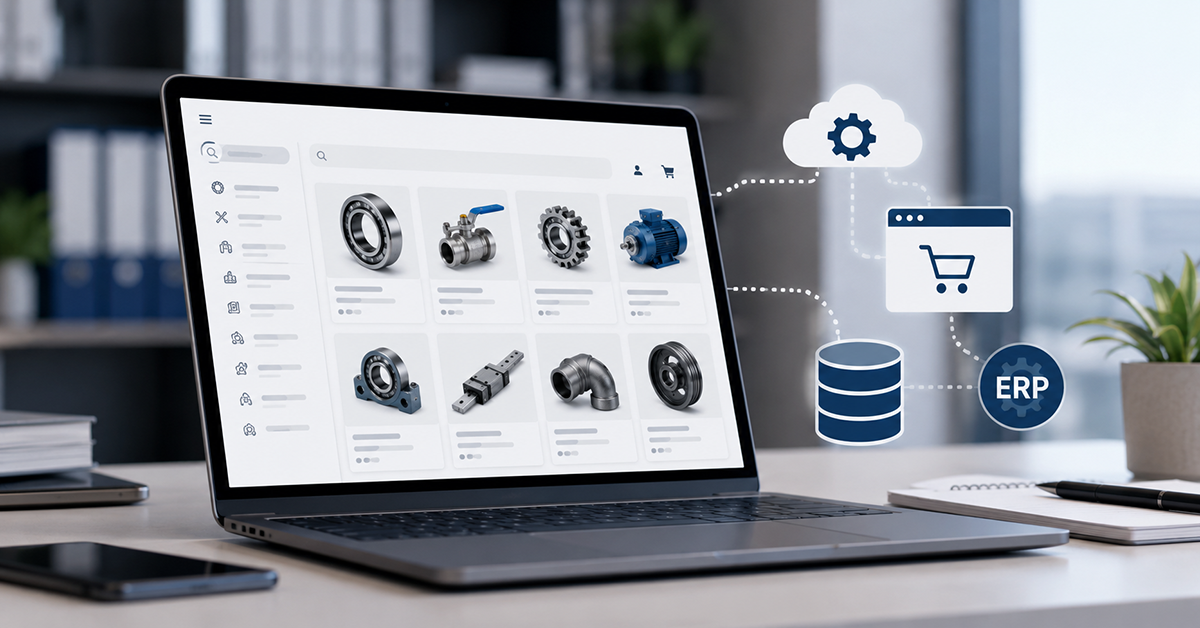
Each piece does one job well: Shopify runs the storefront, DDS keeps a complete and accurate catalog flowing across channels, and Symmetry connects it to your ERP. Decouple the data from the storefront, and neither one caps the other again.
The Resilience Dividend
There’s a quieter benefit to separating these layers: resilience. When your storefront, your product data, and your core systems are bundled into one platform, every future decision becomes all-or-nothing. Pull them apart and you gain durable flexibility—your data stays portable and consistent no matter how your storefront evolves.
And the operational payoff is real: distributors who automate product data delivery this way typically cut manual content work 60–80%, while complete, accurate content drives up to a 30% lift in digital conversion.
FAQs
- We already have decent content in KYKLO. Do we lose it by moving?
No — and this is exactly why an independent data layer matters. DDS sources and manages enriched product content separately from your storefront, so your catalog quality isn’t tied to any one platform. If anything, the goal is a more complete catalog than a bundled platform can provide. - Can Symmetry integrate Shopify with our ERP?
Yes. Symmetry supports Shopify integrations across a wide range of distributor ERPs — including Epicor Eclipse, Epicor Prophet 21, and Infor SX.e, among others. The right approach depends on your workflows, which is why the first conversation is practical and exploratory. - Does DDS manage our product data?
Yes. DDS delivers and manages your product data, including syncing it to Shopify in real time through our app. - Is Shopify replacing our ERP?
No. Shopify complements your ERP rather than replacing it. Your ERP stays the system of record.
Next Step: Get Practical Answers
If catalog completeness or platform capability has started to feel like a ceiling, the most useful next step is a short working discussion with people who do this every day.
DDS customers can schedule a 1-hour consulting call with the Symmetry Commerce team, focused on:
- How Shopify is being used today in B2B and distribution
- What ERP integration typically looks like
- What a realistic migration approach and timeline could be
DDS can join the call if you’d like us involved.
To schedule, email the Symmetry Commerce team at solutions[@]symmetrycommerce.com.
This isn’t a sales call. It’s a chance to get clear, informed answers so you can decide what makes sense for your business.