
Not All Product Data Is Equal: The Six Things That Decide Whether Your Catalog Sells
Two distributors carry the same circuit breaker, from the same manufacturer, at a competitive price. One shows up first when a buyer searches for it, answers every filter the buyer applies, and closes the sale. The other never surfaces at all.
Same product. Same supplier. Different outcome.
The difference isn’t the product. It’s the data behind it. And here’s the part most distributors miss: a SKU can technically “exist” in your catalog and still fail every job that actually matters. It can be in the system and still be invisible to the buyer trying to find it.
That’s the trap of measuring data by presence instead of quality. “It’s in the catalog” feels like a finish line. To the buyer, it’s not even the starting line. Having product data and having good product data are two very different things—and the gap between them is where online sales quietly disappear.
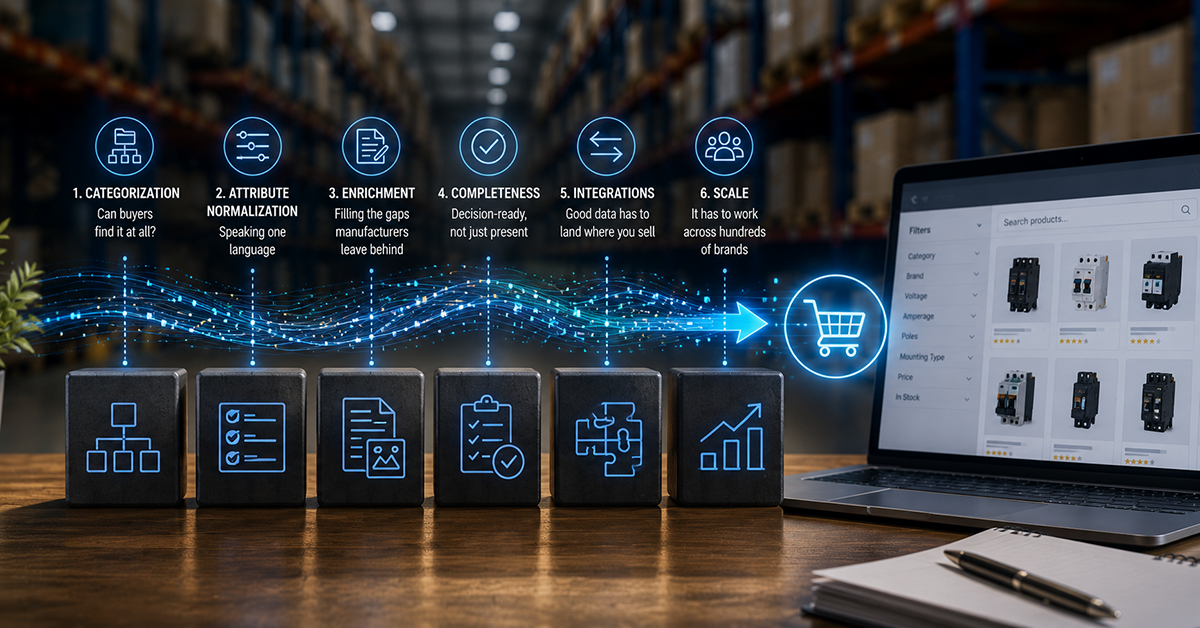
Quality isn’t one attribute you can check off. It’s six dimensions working together. Skip any one of them and the catalog stalls, usually without anyone noticing why. Here’s what each one means and why it decides whether your catalog sells or sits.
1. Categorization: Can Buyers Find It at All?
Categorization is the foundation. If a product lands in the wrong category—or no category—it doesn’t matter how complete the rest of the record is, because no one will ever reach it. Buyers navigate by category and refine from there. A breaker filed under the wrong taxonomy node is functionally missing from your site.
For distributors pulling content from hundreds of manufacturers, this is harder than it sounds. Every manufacturer organizes products their own way. Mapping all of that into one consistent, buyer-friendly taxonomy by hand is slow, inconsistent, and never truly finished as new SKUs arrive. Good categorization means every product lands where buyers expect to find it, across your entire catalog—not just the SKUs someone had time to clean up.
2. Attribute Normalization: Speaking One Language
Here’s a problem that hides in plain sight. One manufacturer sends “120V.” Another sends “120 Volt.” A third sends “120.” To a human, obviously the same thing. To your e-commerce filter, three separate values—which means a buyer who filters for one never sees the products listed under the other two.
Multiply that across voltage, amperage, dimensions, materials, and finishes, across hundreds of brands, and your filters fracture. Buyers either get partial results or give up. Attribute normalization is the work of collapsing all those variations into one standardized value so a single filter returns everything it should. It’s tedious, it’s endless when done manually, and it’s one of the clearest dividing lines between a catalog that converts and one that frustrates.
3. Enrichment: Filling the Gaps Manufacturers Leave Behind
Manufacturer data is rarely complete. Specs are missing, descriptions are thin, images are absent, key attributes are blank. That’s not a knock on manufacturers—it’s just the reality of data that was built for a catalog sheet, not your e-commerce filters and search.
Enrichment closes those gaps: adding the missing specifications, writing usable descriptions, attaching the right images, filling in the attributes buyers actually search and compare on. A bare record might tell a buyer a product exists. An enriched one gives them enough to make a decision without picking up the phone. The distributors winning online aren’t the ones with the most SKUs—they’re the ones whose SKUs are actually decision-ready.
4. Completeness: Decision-Ready, Not Just Present
Completeness is the dimension everyone assumes they have and most don’t. A product is “complete” not when the record exists, but when it contains everything a buyer needs to choose it with confidence: accurate specs, clear descriptions, the right images, and the attributes that matter for that product type.
An incomplete record creates doubt, and doubt is where sales die. The buyer can’t tell if the part fits, can’t compare it against the alternative, can’t be sure it’s what they need—so they bounce to the distributor whose listing answers the question. Completeness is what turns a catalog from a list of things you carry into a tool buyers can actually buy from.
5. Integrations: Good Data Has to Land Where You Sell
Clean, categorized, normalized, enriched, complete data is worth nothing if it’s trapped in a spreadsheet or stuck in a system that doesn’t talk to your storefront. The data has to flow—into your ERP, your PIM, your e-commerce platform—in the format each one expects, and it has to stay current as products change.
This is where a lot of data quality efforts quietly fall apart. Teams clean the data once, then watch it drift out of sync the moment something updates upstream, because there’s no automated path from source to storefront. Integration isn’t a technical afterthought; it’s the dimension that determines whether all the other work actually reaches the buyer. The right approach delivers ready-to-use data directly into the systems you already run—no rip-and-replace, no manual re-uploads every time something changes.
6. Scale: It Has to Work Across Hundreds of Brands
Any of these problems is solvable for fifty SKUs and one manufacturer. A motivated person with a spreadsheet can categorize, normalize, and enrich a small set by hand. The trouble is that no real distributor catalog looks like that.
You’re managing thousands or hundreds of thousands of SKUs across hundreds of manufacturers, each with different formats, different update cycles, and different definitions of “good enough.” Scale is the dimension that breaks manual processes. What works as a one-time cleanup collapses the moment you try to keep it clean, complete, and current across the whole catalog, every day, as new products arrive and specs change. Quality that can’t scale isn’t quality—it’s a snapshot that’s already going stale.
The Real Metric Isn’t “Is It in the System”
Most distributors measure data quality by whether a product is in the catalog. Buyers measure it by whether they can find it, understand it, trust it, and buy it. Those are not the same question, and the distance between them is exactly where online revenue leaks out.
The distributors pulling ahead didn’t clean up their data once. They built a way to keep it categorized, normalized, enriched, complete, integrated, and current—at the scale their business actually runs. That’s not extra work piled onto an already-stretched team. Done right, it’s the opposite: it replaces the manual chasing, cleaning, and reformatting that drains your people today, and it works inside the systems you already have rather than asking you to replace them.
Not all product data is equal. The good news is that the gap between “in the system” and “actually sells” is closeable—and you don’t have to close it by hand.
See where your catalog stands. A quick data audit shows you exactly which of these six dimensions are costing you visibility and sales—and what it would take to close the gap. Request your data audit