
The Cleanup Will Not Happen On Its Own
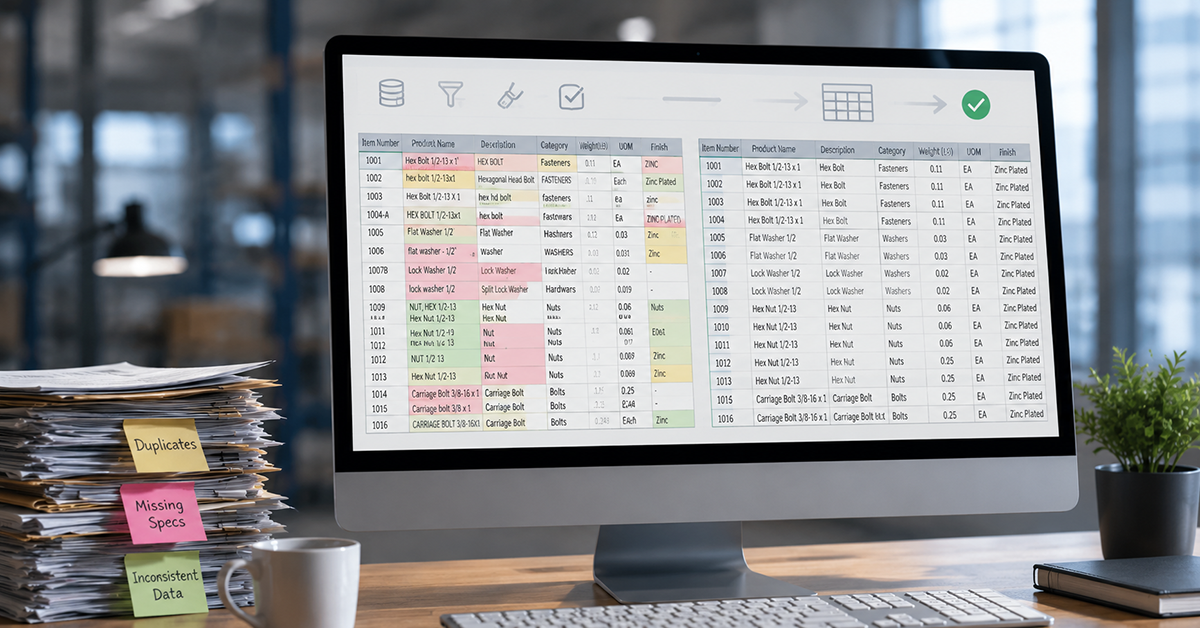
Every quarter you wait, the product data backlog grows faster than your team can clear it. Here’s how mid-market manufacturers get years of cleanup done in weeks — without replacing a single system.
If you run product data at a mid-market industrial manufacturer, you already know the math. You have tens of thousands of SKUs spread across an ERP, a PIM you half-finished implementing, and a few spreadsheets nobody will admit to maintaining. Specs are inconsistent. Names don’t follow a convention. Descriptions range from excellent to a part number copied into a text field.
And the backlog isn’t holding still. Every new product line, every acquisition, every distributor that updates its content requirements adds to the pile faster than your team can work it down. The cleanup project that was supposed to take a quarter is now a permanent line item that never closes.
The honest problem isn’t that your team lacks skill. It’s that catalog cleanup at scale was never their actual job — and it isn’t a job you can hire your way out of one analyst at a time.
Why “we’ll get to it” never gets to it
Most manufacturers try to clean data the only way that’s available internally: incrementally. Someone works a category when there’s a free afternoon. A new hire gets handed the worst of the backlog as an onboarding task. A consultant is brought in for a fixed scope, fixes one slice, and leaves the rest.
The trouble is that incremental cleanup loses a race against incremental growth. While you’re normalizing attributes on bearings, new SKUs are landing in power transmission with the same problems. The pile doesn’t shrink. It moves.
The pattern we see constantly: a manufacturer has a multi-year cleanup “in progress” that has never been more than 60% done at any single point, because the front edge of the backlog keeps regenerating faster than the back edge clears.
This is the moment where a lot of teams reach for a rip-and-replace — a new PIM, a new data governance initiative, a re-platforming project measured in years. Sometimes that’s the right long-term move. But it doesn’t solve the problem in front of you, which is that your catalog is dirty today and your distributors are noticing today.
Accelerated cleanup: clear the backlog first, govern it second
There’s a different sequence that works better for most mid-market manufacturers: separate the one-time cleanup from the ongoing governance, and attack the cleanup as its own focused effort.
Accelerated cleanup means taking your existing catalog — wherever it lives — and putting it through an enrichment process built for industrial product data. Attributes get normalized to a consistent standard. Product names get a convention. Missing specs get identified and filled. Descriptions get rebuilt to be useful to a buyer and readable by a distributor’s e-commerce system. Duplicates and drifted SKUs get surfaced.
The point is to get the whole catalog to a clean, consistent baseline in one concentrated effort — measured in weeks — rather than chipping at it indefinitely.
- 60–80% — reduction in manual data management time
- 80%+ — reduction in manual spreadsheet cleanup
- 4× — faster new SKU launches
What “clean” actually buys you
- Distributors stop deprioritizing your products because the content is finally ready to publish.
- New SKUs and new lines launch faster because there’s a standard to launch them into.
- “Product not as described” returns drop when specs and descriptions are accurate.
- Your team gets out of permanent firefighting and back to work that actually needs them.
The part most cleanup projects get wrong
Here’s the trap. You finally get the catalog clean — and six months later it’s drifting again, because nothing changed about how data enters and moves through your systems. Cleanup without governance is a treadmill.
But the reverse mistake is just as common: trying to stand up perfect long-term governance before you’ve cleared the mess. That’s how cleanup projects stall for years. You’re trying to architect the future while drowning in the present.
The sequence that works: clear the backlog with a focused accelerated cleanup, get to a clean baseline fast, and stand up governance to hold that baseline — in that order. The cleanup buys you the breathing room to do governance right.
And governance doesn’t have to mean DDS owns your data architecture forever. For many manufacturers, the right model is a coexistence one: DDS handles the accelerated cleanup and the ongoing enrichment heavy-lifting, while your internal team — or a dedicated data governance partner — owns the long-term stewardship and architecture. The work gets split along the line of who’s actually best at each part.
This is not a rip-and-replace
Worth saying plainly, because it’s the first fear that comes up: accelerated cleanup doesn’t mean swapping out your ERP or PIM. DDS reads from the systems you already have and delivers clean, normalized, distributor-ready data back into them. We replace the manual cleanup process — not your core systems.
That’s the whole point of doing it this way. You don’t have to win a multi-year platform argument with IT to start fixing your catalog. You can clear the backlog now and keep every system you’ve already invested in.
Stop managing the backlog. Clear it.
See what your actual catalog looks like after an accelerated cleanup — on a single category, with your real data, in a short working session.